Ero sivun ”3072” versioiden välillä
p |
(Virranottokenkä ja kitkarenkaat) |
||
| Rivi 13: | Rivi 13: | ||
| ma_pituus = 14,1 cm | | ma_pituus = 14,1 cm | ||
| moottori = [[LFCM]] | | moottori = [[LFCM]] | ||
| + | | virranottokenkä = 7164 | ||
| + | | kitkarenkaat = 7154 | ||
| + | | kitkarenkaat-lkm = 4 | ||
| symbolit = {{symbolit|A0|A6|C0}} | | symbolit = {{symbolit|A0|A6|C0}} | ||
}} | }} | ||
Nykyinen versio 6. tammikuuta 2022 kello 18.07
| DB-Baureihe V 100 / DB-Baureihe 212 Märklin 3072 |
|
|---|---|
 212 218-5 |
|
| Esikuva | |
| DB-Baureihe V 100 / DB-Baureihe 212 | |
| Lukumäärä | 381 |
| Valmistusvuodet | 1962–1965 |
| Poistunut käytöstä | 2004 |
| Pituus | 12 300 mm |
| Massa | 63,0 t |
| Huippunopeus | 100 km/h |
 |
|
| Pituus | 14,1 cm |
| Moottori | LFCM |
| Virranottokenkä | 7164 |
| Kitkarenkaat | 7154 (4 kpl) |
   |
|
»Die Baureihe V 100 ist ein von der Deutschen Bundesbahn (DB) Ende der 1950er Jahre beschaffter Lokomotivtyp mit dieselhydraulischem Antrieb, der auf nicht elektrifizierten Nebenbahnen die dort verwendeten Dampflokbaureihen ersetzen sollte.»
(Wikipedia)
»Die Baureihe V 10020 bzw. 212 ist eine leistungsstärkere Variante der V 100. Sie wurde nach dem Prototyp V 100 006, ab 1960 als V 100 2001 bezeichnet, von 1962 an in Serie in Dienst gestellt und war im Gegensatz zur im Nebenbahndienst eingesetzten V 10010 auch für den Haupt- und Steilstreckendienst vorgesehen.»
(Wikipedia)
3072, Diesel-hydraulic locomotive "V 100"
The locomotive 3072 is bought from Germany in June 1978, when I was working near ULM as trainee for 10 weeks. This was the first loco I have ever bought!
The conversion of this locomotive with Märklin mfx conversion set (item 60924) is not officially supported. Conversion needs modifications to locomotive metal body.
The V 100 (later marked as 211 and 212) is a multi-purpose diesel locomotive with a working weight of 63.2 tons and a length of over 12 m (39ft. 4"). The new types develop about 1000 kW, and this power is transmitted by means of cardan shafts to the 4 axles arranged in 2 trucks.
To suit the tractive force of the powerful motor to the requirements of passenger and freight traffic, a two speed gearbox is used. The gear ratio must be selected when the locomotive is stationary. In low gear the locomotive exerts its maximum speed of only 65 km/h (40 mph), while in high gear it reaches 100km/h (62 mph).
Dokumentit
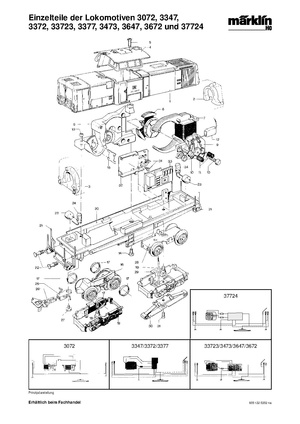
Varaosia
| Rubber tyres | 7154 |
| Lamp | 6001 |
| Shoe | 7164 |
Muunnos digitaaliseksi
MFX decoder
Locomotive 3072 "BR212" conversion was made with Mfx decoder kit 60923.
Before conversion
Here are some pictures from the engine prior the conversion
| Top view. | |
| Right side view. |


Cover removed, original engin clearly visible. There is moderately space inside this locomotive.
| Cover removed | |
| Details: Engine and reverse unit | |
| Details: Lamp | |
| Details: Lamp. | |
| Details: Engine and reverse unit. |


Parts removed. Motor block with gears is a separate block from locomotive body. Also wheels are mounted to a separate block. An H-shaped piece is part of the transmission between motor block and wheel block.
| Parts removed. Motor block with gears is a separate block from locomotive body. Also wheels are mounted to a separate block. An H-shaped piece is part of the transmission between motor block and wheel block. | |


| Locomotive body after cuttting the metal away. Minidrill bits did the cutting fine. |


Motor conversion to high effiency propulsion type
Motor block now fitted to enlarged place.


Replacing reverse unit with Mfx decoder
New decoder connected to and ready to be tested.
