Raspberry Pi
Versio hetkellä 31. tammikuuta 2016 kello 17.00 – tehnyt Osk (keskustelu | muokkaukset)

Sekalaisia ideoita ja ajatuksia Raspberry Pi:n käytöstä pienoisrautatien kanssa.
Märklinin ohjaus Raspberry Pi:llä
Kommunikointi eri Raspberry Zero -korttien välillä voidaan tehdä RS-485 väylää käyttäen ja esimerkiksi MODBUS-protokollalla. Tämä protokolla mahdollistaa yksittäisten bittien ja sanojen kirjoittamisen ja lukemisen toisilta väylään kytketyiltä laitteilta.
GPIO ajatuksia
Seuraavia lähtöjä ja tuloja olisi hyvä olla:
- tulot
- on/off-tulo, esim kontaktikiskot (vrt S88)
- lähestymisanturi, esim junan havaitsemiseen ilman kosketusta.
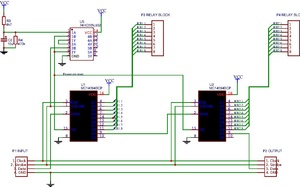
- lähdöt, toteutus esim MC14094-piirillä
- on/off relelähtö: jänniteen kytkeminen oheislaitteelle
- pwm-lähtö: esim valaistuksen voimakkuuden säätäminen
- pulssilähtö: esim vaihteiden ohjaukseen. Pulssin pituus säädettävissä, kuten esim CS:ssä.
- Servo. PWM-lähtö servon ohjaukseen
- Moottoriohjaus. Tasavirtamoottorit ja askelmoottorit.
GPIO lähdöt: http://pinout.xyz/
Optotriac esim MOC3052
piirivalintaan http://www.onsemi.com
Junan IR havainnointi
https://www.azatrax.com/ir-model-train-detector.html
Raspberry Pi:n versiot
| Raspberry Pi 1 Model A |
Raspberry Pi 1 Model A+ |
Raspberry Pi 1 Model B |
Raspberry Pi 1 Model B+ |
Raspberry Pi 2 Model B |
Raspberry Pi Zero | |
|---|---|---|---|---|---|---|
| Julkaistu: | Helmikuu 2013 | Marraskuu 2014 | Huhti-kesäkuu 2012 | Heinäkuu 2014 | Helmikuu 2015 | Marraskuu 2015 |
| Hinta: | US$25 | US$20 | US$35 | US$25 | US$35 | US$5 |
| SoC: | Broadcom BCM2835 (CPU, GPU, DSP, SDRAM, yksi USB-portti) | Broadcom BCM2836 (CPU, GPU, DSP, SDRAM, yksi USB-portti) | Broadcom BCM2835 | |||
| CPU: | 700 MHz single-core ARM1176JZF-S | 900 MHz quad-core ARM Cortex-A7 | 1 GHz ARM1176JZF-S single-core | |||
| GPU: | Broadcom VideoCore IV @ 250 MHz OpenGL ES 2.0 (24 GFLOPS) MPEG-2 and VC-1 (with license), 1080p30 H.264/MPEG-4 AVC high-profile decoder and encoder | |||||
| Memory (SDRAM): | 256 MB (shared with GPU) | 512 MB (shared with GPU) as of 15 October 2012 | 1 GB (shared with GPU) | 512 MB | ||
| USB 2.0 ports: | 1 (direct from BCM2835 chip) | 2 (via the on-board 3-port USB hub; one USB port internally connected to the Ethernet port) | 4 (via the on-board 5-port USB hub; one USB port internally connected to the Ethernet port) | Micro-USB (direct from BCM2835 chip) | ||
| Video input: | 15-pin MIPI camera interface (CSI) connector, used with the Raspberry Pi camera or Raspberry Pi NoIR camera | |||||
| Video outputs: | HDMI (rev 1.3 & 1.4), 14 HDMI resolutions from 640×350 to 1920×1200 plus various PAL and NTSC standards, composite video (PAL and NTSC) via RCA jack | HDMI (rev 1.3 & 1.4), 14 HDMI resolutions from 640×350 to 1920×1200 plus various PAL and NTSC standards, composite video (PAL and NTSC) via 3.5 mm TRRS jack shared with audio out | HDMI (rev 1.3 & 1.4), 14 HDMI resolutions from 640×350 to 1920×1200 plus various PAL and NTSC standards, composite video (PAL and NTSC) via RCA jack | HDMI (rev 1.3 & 1.4), 14 HDMI resolutions from 640×350 to 1920×1200 plus various PAL and NTSC standards, composite video (PAL and NTSC) via 3.5 mm TRRS jack shared with audio out | Mini-HDMI, 1080p60, RCA composite video via GPIO | |
| Audio inputs: | As of revision 2 boards via I²S | |||||
| Audio outputs: | Analog via 3.5 mm phone jack; digital via HDMI and, as of revision 2 boards, I²S | Mini-HDMI, stereo audio through PWM on GPIO | ||||
| On-board storage: | SD / MMC / SDIO card slot (3.3 V with card power only) | MicroSD slot | SD / MMC / SDIO card slot | MicroSD slot | ||
| On-board network: | None | 10/100 Mbit/s Ethernet (8P8C) USB adapter on the third/fifth port of the USB hub (SMSC lan9514-jzx) | None | |||
| Low-level peripherals: | 8× GPIO plus the following, which can also be used as GPIO: UART, I²C bus, SPI bus with two chip selects, I²S audio +3.3 V, +5 V, ground |
17× GPIO plus the same specific functions, and HAT ID bus | 8× GPIO plus the following, which can also be used as GPIO: UART, I²C bus, SPI bus with two chip selects, I²S audio +3.3 V, +5 V, ground.
An additional 4× GPIO are available on the P5 pad if the user is willing to make solder connections |
17× GPIO plus the same specific functions, and HAT ID bus | 40x GPIO | |
| Power ratings: | 300 mA (1.5 W) | 200 mA (1 W) | 700 mA (3.5 W) | 600 mA (3.0 W) | 800 mA (4.0 W) | ~160 mA (0.8 W) |
| Power source: | 5 V via MicroUSB or GPIO header | |||||
| Size: | 85.60 mm × 56.5 mm – not including protruding connectors | 65 mm × 56.5 mm – (same as HAT board) and 10 mm high | 85.60 mm × 56.5 mm – not including protruding connectors | 65 mm × 30 mm × 5 mm | ||
| Weight: | 45 g | 23 g | 45 g | 9 g | ||
| Console: | Micro-USB cable or Adafruit serial cable with optional GPIO power connector | |||||
| Model A | Model A+ | Model B | Model B+ | Generation 2 Model B |
Zero | |