Dekooderit
DELTA Decoders
Generally, "DELTA" decoders and "digital" decoders understand all the same Märklin/Motorola signal on the track. This signal may be generated by Central Units, Delta Controls, Intelliboxes, DDL, etc. The terms "DELTA" and "digital" are used only for marketing purposes. "Delta" are the low-end decoders, "digital" are the full-featured decoders. There is no one-and-only DELTA decoder. DELTA decoders have been made in many varieties.
The DELTA decoder 6603 with 701.13 chip
| chip | 701.13 |
| headlight | directional |
| functions | - |
| addresses | 15 digital, configured by solder bridges, automatic analog mode |
| motor | SFCM, LFCM, DCM |
The early DELTA decoder had a 701.13 chip, addresses are configured by solder bridges. The full address range can be used with some additional soldering. The advantage is that this decoder automatically detects the presence of analog track voltage and locos run on analog track. The decoder is suitable for standard Märklin motors, i. e. for the small and large flat collector motors (SFCM, LFCM) and for the drum collector motors (DCM).
- get 15 Delta addresses by Rutger Friberg, on FTP-server Märklin USA
- get all digital addresses by Rutger Friberg, on FTP-server Märklin USA
- Delta decoder schematics and modifications (functions, addresses) by Dr. Michael König
- get aux. function output by Märklin USA
- drive a DC motor by Märklin USA
The DELTA decoder 6603 with 701.17 chip
| chip | 701.17 |
| headlight | directional, always on, brightness depends on speed, flickering |
| functions | - |
| addresses | DIP switch, 15 digital, one for analog mode |
| motor | SFCM, LFCM, DCM; 27 speed steps |
| size | 36 × 21 × 4 mm |
Later types had a 701.17 chip, 15 addresses can be configured by DIP-switches. Although the chip supports remote control of the head lights, this is not used but the headlights are driven by the motor outputs. Therefore headlights are directional, cannot be turned off, and lamp brightness is proportional to motor speed. When the loco stands still, lights go off. One end of the lamp connections is the loco chassis, therefore lights are flickering. To run a loco on analog, the "analog" loco address has to be set. The motor output supports 27 speed steps but they may not be noticed, because the motor output is not a control loop. The motor output drives standard Märklin motors, i. e. SFCM, LFCM, and DCM. The 6603 as a spare decoder disappeared in 2000 but has still been used in factory-equipped locos in later years.
Schematics can be found at the website of Dr. König. Several websites describe DIY modifications on how to get the lights flicker-free, how to get the lights permanently on and remote controllable, how to address any of all 80 digital addresses, how to drive a DC motor, and even how to make the extra functions f1 - f4 available:
- Delta decoder schematics and modifications (functions, addresses) by Dr. Michael König
- Delta decoder with f1 + f2 function output by Bo Brændstrup
- Delta decoder modifications: aux. function, 80 adr. by Kenneth Pallund
- drive a DC motor by Märklin USA
- German "manual" on how to wire the 6603 and other decoders by Ralf Büker
The DELTA decoder 66031
| chip | 701.21 |
| headlight | directional, always on, constant brightness, flicker-free, protected |
| functions | telex, protected |
| addresses | DIP switch, 15 digital, one for analog mode |
| motor | SFCM, LFCM, DCM; 27 speed steps, protected |
| size | 36 × 21 × 4 mm |
The 66031 is a DELTA decoder with a 701.21 chip, introduced in 1997. Headlights are directional, permanently on, independent from speed. Lamps can be wired flicker-free. An extra function is available for telex couplers or other effects, this function is activated by repeated direction reversals of the loco. The motor output supports 27 speed steps. The motor output drives standard Märklin motors, i. e. SFCM, LFCM, and DCM. All outputs (motor, light, and function) are overload and short-circuit protected. Due to limited features of the 701.21 chip no DIY modifications exist to make further features available. Positive and negative rectified track voltage is available for flicker-free lighting and as supply for other circuits, e. g. sound modules. Addresses are set with a DIP switch, providing 15 digital addresses and one analog mode. The full address range can be used with some soldering.
- Schematic and Pictures of the 66031 from myself.
- Delta decoder 80 adresses by Kenneth Pallund
- drive a DC motor by Märklin USA
- German "manual" on how to wire the 66031 and other decoders by Ralf Büker
The DELTA decoder 66032
| chip | 701.43 |
| headlight | directional, always on, constant brightness, flicker-free, protected |
| functions | telex, protected |
| addresses | DIP switch, 80 digital, automatic analog mode |
| motor | SFCM, LFCM, DCM; 27 speed steps, protected |
| size | 36 × 21 × 4 mm |
The 66032 is the current DELTA decoder since 2002. In its factory-delivered form the features are comparable to the 66031: Headlights are directional, permanently on, independent from speed. Lamps can be wired flicker-free. An extra function is available for telex couplers or other effects, this function is activated by repeated direction reversals of the loco. The motor output supports 27 speed steps. The motor output drives standard Märklin motors, i. e. SFCM, LFCM, and DCM. All outputs (motor, light, and function) are overload and short-circuit protected. Positive and negative rectified track voltage is available for flicker-free lighting and as supply for other circuits, e. g. sound modules. Addresses are set with a DIP switch, and this decoder is the first DELTA decoder providing all 80 digital addresses. The decoder automatically detects analog mode.
If you want the headlights not permanently on but remotely controllable via the "function" button of a 6021 or 66045 delta control, the modification is surprisingly simple; and the decoder becomes a true successor also of the 6080. In addition, the output intended for a telex coupler, which is by default controlled by repeated direction reversals, can be converted to be remotely controllable via the "f1" button of a 6021 or equivalent control unit.
- modifications of the 66032
- remotely controllable function (in English and German) by Jürgen Schad
- schematic of the 66032 by Joachim Schröder
Special DELTA decoders
Sometimes non-standard decoders are built into locomotives. Reasons can be space limitations or electrical reasons.
- Steam locos with a 2'2'T26 tender or cabin tender (BR01, BR03, BR41, BR43, BR44, BR50, BR52) have a delta decoder, spare number 664150 or 600258, of special larger size that is customized to fit onto the tender weight and includes a lamp socket for rear light. A digital equivalent is listed further below.
- The model of the E69 ("Pauline"), order number 34475, is very small and has a DC motor, therefore a standard 66031 is unsuitable. The delta decoder inside here has a 701.22 chip, and is in fact a regulated decoder, where the adjustment potis are not soldered on the circuit board, but replaced by fixed resistors.
- A detailed list with descriptions of many special DELTA decoders is at the Special DELTA decoder overview (in German) by Hans-Günter Heiserholt
Digital Decoders
The c80 was the first decoder for Märklin digital. Later came the c90 decoder and the simpler DELTA decoder. Compared to the DELTA decoders they have an auxiliary function and full address selection. The aux. function is directional and the brightness is independent from speed. An 8-pole DIP switch allows the configuration of all 80 digital addresses.
The c80 digital decoder, number 6080
| chip | Zymos M60349, LME03, 701.13 |
| headlight | directional |
| functions | aux. function |
| addresses | DIP switch, 80 digital, automatic analog mode |
| motor | SFCM, LFCM, DCM |
| size | 36 × 21 × 9 mm |
The c80 was the first digital decoder, and had different chips in its time of evolution. It is not produced any more. It has automatic detection of analog track, supports directional headlights which can be remotely switched off. It understands the Motorola 1 protocol. It disappeared in 2000. Nowadays a 66032 can offer the same features, with flicker-free headlights and protected outputs.
The decoder is also registered under spare number 602850.
The c81 digital decoder, number 6081
| chip | Zymos M60349, LME03, 701.13 |
| headlight | directional |
| functions | aux. function |
| addresses | DIP switch, 80 digital, automatic analog mode |
| motor | DC |
| size | 36 × 21 × 9 mm |
The c81 is identical to the c80 except for the motor driving stage. The c81 drives DC motors, whereas the c80 is used for standard märklin motors. It disappeared in 2000.
Digital high performance decoders
With the c90 high-performance decoder Märklin set a new reference in loco decoder performance. The decoder evaluates the back EMF of the motor (that is the generated voltage when a motor works as generator) and uses this feedback in a control loop of the motor. By these means, the motor is driven such that a constant speed is achieved. The performance has been further improved with the current 60902 decoders. With these, at speed step 1 (of the range 1 - 27) locos crawl at 5 mm/s and slower so that it is a pleasure to watch the rods of a steam engine.
To produce a back EMF the motor must be a DC motor. This means that the conventional field windings of a märklin motor have to be replaced by a permanent field magnet. Furthermore, the usual three-pole armatures are replaced by five-pole armatures to get improved running characteristics.
The c90 high performance digital decoder, number 6090
| chip | 701.13 |
| headlight | directional |
| functions | aux. function |
| addresses | DIP switch, 80 digital, automatic analog mode |
| motor | DCM converted to DC |
| size | 36 × 21 × 9 mm |
The c90 came as a set of a decoder, a permanent field magnet to replace the field windings, a five-pole armature to replace the three-pole drum collector armature, a corresponding motor cover, and two inductors. An inductor is soldered to each brush to suppress inductive spikes from the motor otherwise disturbing or damaging the decoder. It disappeared 1998.
The c90 decoder has a 701.13 chip, hence it only understands the older Motorola 1 protocol. The motor control loop is built with an operational amplifier and further discrete components, it is not integrated in the decoder chip. Maximum speed and acceleration parameter can be adjusted with potentiometers. Analog track voltage is automatically detected. Headlights are directional, flicker, and can be remotely switched. No other functions are provided.
The decoder only is registered under the two spare numbers 648680 and 614090. Some people say one is stronger than the other, but they seem to be basically identical.
The 6090 set consists of:
- 386820: rotor
- 386940: motor cover
- 389000: field magnet
- 516520: inductor
- 614090: decoder (obsolete)
- 648680: decoder (current)
Links:
- Schematic of the 6090-decoder by Thomas Krüger, at Michael Prieskorn
- The same schematic and pictures at Kenneth Pallund
- Flicker-free lights, i.e. where to get the orange cable, by Hanno Brüninghaus
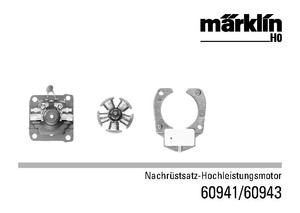
The 60901 DCM high performance decoder set
Like the 6090 set, the 60901 comes as a set of decoder and motor components to convert a conventional drum collector motor (DCM) to DC operation. It was introduced in 1997.
The motor plate is usually fixed with 10 mm long bolts, spare number 785120. Sometimes the longer 12 mm bolts are appropriate, spare number 785140. The 3.9 uH inductors are separately available under spare number 516520. A decoder clip-on holder is available as spare part 258820, which is usually fixed with the M2 bolt 756100 (slot-head) or 786790(cross-head).
The 60901 set consists of:
- 386820: rotor (blue mark)
- 386940: motor cover
- 389000: field magnet
- 516520: inductor
- 601460: pair of brushes
- 60902: decoder
Links:
The 60902 high performance decoder
| chip | 701.22 |
| headlight | directional, flicker-free, protected |
| functions | aux. function, f1, f2 (all protected); f4 momentum off |
| addresses | DIP switch, 80 digital, automatic analog mode |
| motor | DC; 60901 converts a DCM to DC, 60904 converts LFCM to DC |
| size | 36 × 21 × 9 mm |
The 60902 is the successor of the c90, and was introduced in 1997. Its motor regulation performance has been improved over the c90. The control circuit is integrated in the decoder chip, which is a 701.22. The decoder provides two extended functions f1 and f2, and the circuit board has provision for further components to provide functions f3 and f4, but by default f4 is used to turn off the acceleration and deceleration delay to get instant control over the loco. The decoder chip understands the Motorola 2 protocol, provides 27 speed steps, has automatic analog detection, and flicker-free lighting. Positive and negative rectified track voltage is available for flicker-free lighting and as supply for other circuits, e. g. sound modules.
The 60902 is just the decoder without motor parts, and may be used to replace the decoder of a c90 loco to get improved motor control and additional functions. Complete sets with the required motor parts are available as number 60901, 60903, or 60904. See below.
There are variants of the 60902 with different function outputs. The version with the functions f2 and f3, but no f1, has number 519090 (source: Hans-Günter Heiserholt, more infos) and is used, for example, in the E40 from the starter set 29855. (Infos by Hans-Günter Heiserholt). The version with all three functions f1, f2, and f3, is used, for example, in the BR18.4 from the starter set 29855. Another three-function version, with a different printed circuit board, but same functionality and size, has been used in the V160 from the starter set 29845, see below.
Links:
- Schematic and extensions of the 60902-decoder (in English and German) by Jürgen Schad
- Detailed description how to extend the 60902-decoder with more function outputs (follow the link 60902-Tuning) by Michael Prieskorn
- Detailed description how to extend the 60902-decoder with more function outputs (in German) by Hanno Brüninghaus
- German "manual" on how to wire the 60902 and other decoders by Ralf Büker
The 60902 decoders in miniature size
| equivalent to | 60902 |
| spare part no | 603858, 603808, 605549, 603462 |
| built in model | 603858: E18-15, 37681 603808: BR86, 26508 605549: E40, 37401 603462: Dampfspeicherlok, 37250, 26504 |
| chip | 701.22 B |
| functions | no f1 - f3, f4 momentum off |
| motor | DCM, converted to DC |
| size | 22 × 16.5 × 6 mm |
These are small-size versions of the 60902. Due to space limitations the decoder has no external functions. The different order numbers are basically the same decoder and differ only in the attached cables which are tailored to the specific model. A decoder clip-on holder is available as spare part 456200, which is usually fixed with the M2 bolt 756100.
Links:
- Decoder connections as part of a conversion info (German) by Jochem Holzhäuser, on the MIST7 page
- Picture 1 and 2 of the 603858 from Hans-Günter Heiserholt
The 60902-equivalent special decoder of the Cargo Sprinter (can motor, pickup switch)
| equivalent to | 60902 |
| spare part no | 207314 |
| built in model | Cargo Sprinter 3709x |
| chip | 701.22 |
| functions | only aux. function |
| motor | DC |
This decoder lacks all extra functions, not even f4 is available to turn off the acceleration and deceleration delay to get instant control over the motor. The decoder has an extra relay for pickup shoe switching so that supply is always taken from the front pickup shoe.
The 60902-equivalent special decoder of the S-Bahn Loks (60902 with pickup switch)
| equivalent to | 60902 |
| spare part no | 608074 (from 26511) |
| built in model | S-Bahn BR143 26507 BR110 26511 |
| chip | 701.22 |
| functions | aux. function, f4 momentum off |
| motor | DCM |
This decoder lacks all extra functions, but f1 can rather easily be added. The decoder has two pickup inputs, to let the decoder run from the pickup at the front of the train. A function output switches connection with the supply from the rear pickup, which is most suitable for car interior lighting. By default, this function is wired together with the headlights, but can be converted to f1. Loco rear headlights (towards cars) can be permanently deactivated with a jumper. Pickup switching can be permanently deactivated with another jumper.
- Pictures of the BR143 by Hanno Brüninghaus
- For conversions (in German) and (questionable) schematics, see Wendezüge Umbau Info by Hans-Günter Heiserholt
The 60902-equivalent special decoder of the V 200
| equivalent to | 60902 |
| spare part no | 601944 |
| built in model | V200: 37803 |
| chip | 701.22 B, early versions 701.17 |
| functions | f1 - f4, for sound and light effects |
| motor | DCM, converted to DC |
This is the decoder of the V200 with sound module (spare no. 601865). Function outputs are connected to the sound module. Further motor signals are wired to the sound module to allow motor synchronous sound.
Early locos had a 701.17 chip, the mass production has a different board with a 701.22 chip. This is very interesting since the two chips have very different properties. The .17 has external motor control circuitry, the .22 has it built in. The .22 would allow to use f4 to turn off acceleration delay, but the .17 does not. However, Märklin has chosen to use all 4 functions for sound and light effects. This decoder proves also that the .17 chip supports automatic analog track detection.
The 60902-equivalent special decoder of the V 160, BR 216
| equivalent to | 60902 |
| spare part no | 602759 |
| built in model | V160: from 29845 set BR216: 37744 E18-40: 26509 |
| chip | 701.22 B |
| functions | f1 unused, f2 + f3 for sound effects, f4 momentum off |
| motor | DCM, converted to DC |
| size | 36 × 21 × 9 mm |
This is the decoder of the V160 / BR 216 with sound module (spare no. 602749). Dimensions are identical to the 60902. f2 and f3 are connected to the sound module, f1 is unused and readily available. f1 has a more powerful driver transistor than f2 and f3.
- Locos with sound by Michael Prieskorn
- picture of the decoder on back of the sound board, by Michael Prieskorn
- Details about the 602749 sound module
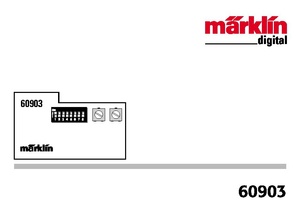
The 60903 SFCM high performance decoder set
The 60904 LFCM high performance decoder set
The 60905 high performance decoder
The 60905-equivalent special decoder of the BR 18.1 (Württ. C), BR 59 (Württ. K), BR 17 (Preuss. S10), BR 55 (Preuss. G8.1)
The 60905-equivalent special decoder of the E 69
The 6090x-equivalent special decoders for steam tender locos
The 6080-equivalent special decoder of the BR 18.1 (Württ. C), BR 59 (Württ. K), BR 17 (Preuss. S10), BR 55 (Preuss. G8.1)
More 6090- and 60902-equivalent special decoders
C-Sinus decoders
Accessory and function decoders
The 60960 loco function decoder
The 60961 loco directional function decoder
The k84 (6084) accessory decoder
The k83 (6083) turnout decoder
The k73 (6073) turnout decoder
The 74460 C-track turnout decoder
Moottorien muunnossarjat
| 609x1 DCM-moottoreille |
609x2 Pelkkä dekooderi |
609x3 SFCM-moottoreille |
609x4 LFCM-moottoreille | |||||||||
|---|---|---|---|---|---|---|---|---|---|---|---|---|
| Digital |
|
|
|
| ||||||||
| mfx |
|
|
|
| ||||||||
| mfx |
|
|
|
|